Find your creative voice – what do I draw next?
I’ve found the best advice is to keep it simple. I am lucky enough to live in Dorset which is full of inspirational views. There are so many views and places that it can often be overwhelming.
You may ask yourself, what will make a beautiful view or subject? Most recently, I’ve tried to simplify my process, so that I avoid wasting time. If I am out for a walk and the light is just right, I challenge myself to take a few notes, make a quick sketch and capture more information using my camera phone. Later, I use this as the inspiration for a colour study. It might work or it might not but I know I always learn from the experience, either way.

I hope that my workshops encourage you to look for inspiration locally, giving you opportunity to see your local views with fresh eyes and making the ordinary extraordinary.
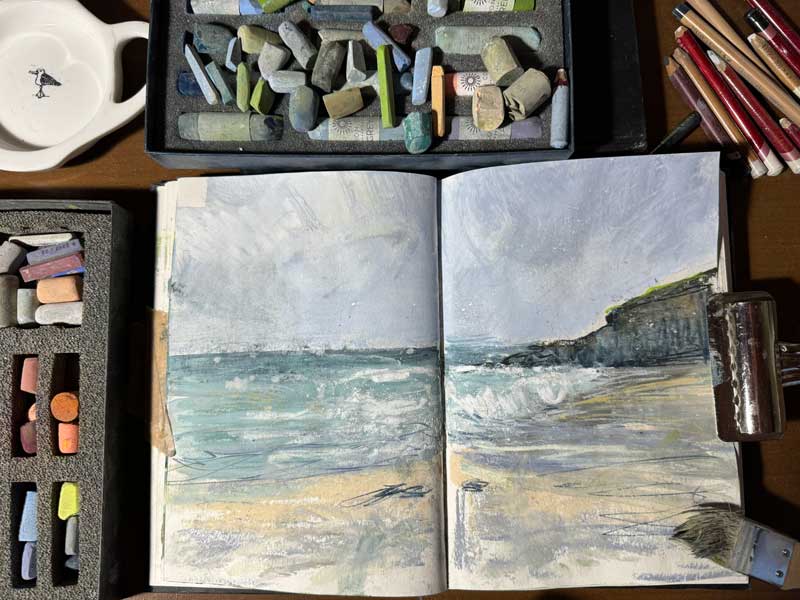
My students often find they struggle for time. Juggling life and art can be a tricky balance. “Little and often” is a very good approach to your art practice. Working in a small sketchbook keeps your eye in and can be inspiration for larger works of art. Keeping your art kit in order means that when you have time, you will be able take advantage easily.
Working in a sketchbook with soft pastels
If you like the idea of sketchbooking with pastels. Here’s how I do it. Prepare a simple selection of colours, suited to the colours of your landscape. I like using pastel pencils and sticks, with a little liquid and a brush, soft pastel returns to pigment so I paint a wash of colour. The same binder that keeps the pigment as a stick form then fixes it to the page. I then spray it with fixative when I get back to the studio. I guess there’s slightly less pastel on the paper as I use liquid to create a wash of colour with it. Like all things new, it will take you a while to find the correct balance but it’s worth persevering. I also like using watercolour pencils and you can use water paints. There are no rules, just do what suits you.

Getting your art kit ready is as important as doing the artwork. Whether painting outside or doing a workshop, I recommend selecting your colours ahead of starting. Selecting your colours ahead of starting and keeping them stored in a pot, it means you can just focus on creating the artwork. I have a little back pack that is always packed with my art kit, ready for a creative day out with my flask of tea. That way you are always ready to grab some time for happy pastelling.
3 TIPS TO CONSIDER.
1. DEVELOP YOUR OWN ARTISTIC VOICE.
I emphasise developing a working practice to my students. I help them develop a process that they can follow to enable them to find their own artistic voice. The secret to success is planning. The work that goes in before the pastel hits the paper. Most important, is your choice of subject. I think it’s important to develop your unique themes. What makes you happy? Is it a favourite place, walk or view. Are you a sea person or a mountain person, animals or townscapes? Start to create your own reference images using your own photos and sketches. You’ll find that your artwork develops to new levels from this authentic approach. Your minds eye will have captured so much more information you will imagine it has. All of that and more will be in your artworks which you will use alongside sketches and photos.
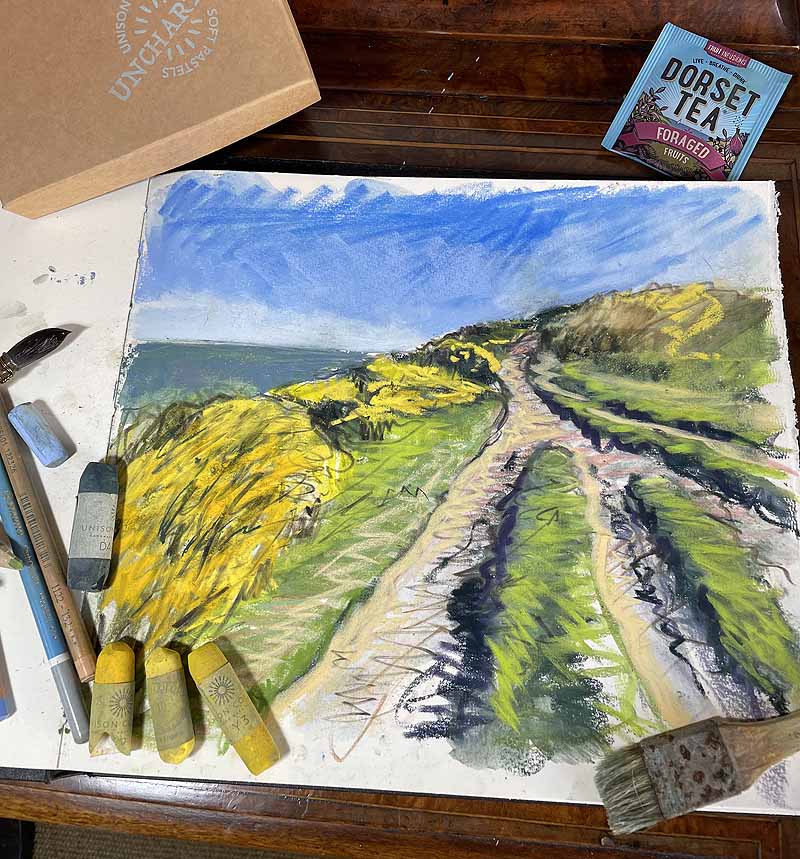
2. START WITH A COLOUR STUDY.
A smaller scale and using a scrap of paper means I can be freer with my marks and explore colour too. I think of it like a, ‘getting to know you’ sketch, a chance to explore the image a little before starting the final artwork.
This preparation is essential, choose your colours carefully. If the colours look good together ahead of starting, they’ll make a gorgeous artwork. This process means I keep my colours clean and luminous rather than grabbing too many colours and creating a muddy mess. For my seascapes, I know that St Ives is always beautiful but the light, well that’s a special thing. I knew it would be the ideal scene to demonstrate some of my favourite soft pastel painting techniques. I hope that by sharing these views, I inspire my students to see their own views with new enthusiasm.
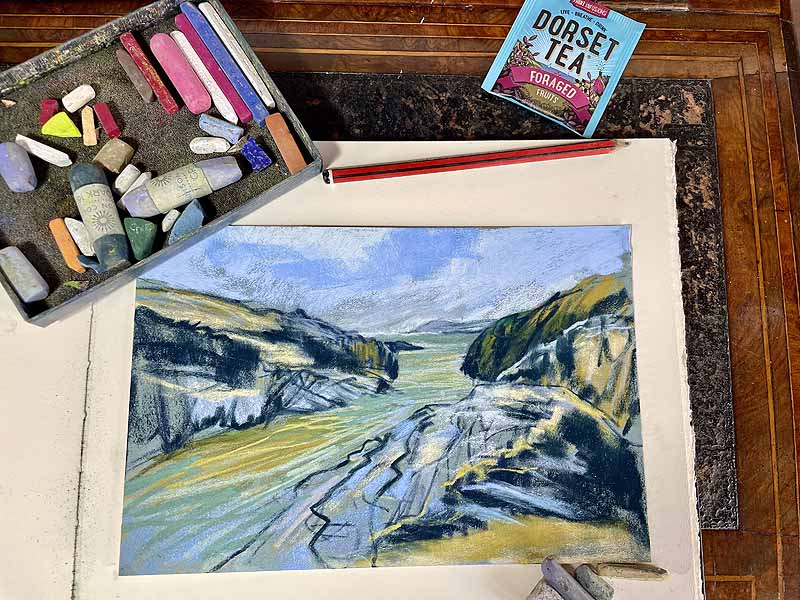
3. IT’S A CUP OF TEA FOR ME!
It’s so important to take a break and come back to your artwork with fresh eyes. Boil that kettle and savour your artwork over a favourite brew or even tipple. Especially after the initial drawing out stage. You’ll be able to spot areas in your artwork that need a tweak or something that’s distracting or just in the wrong place with ‘fresh eyes’ when you return. It’s also helpful to turn artworks and reference images upside down, and then compare. This new way of seeing your artwork will help you compare angles, shapes and proportions much more effectively. It’s also important to remember, taking regular breaks avoids eye strain and neck and arm aches and pains that are all too often forgotten.
If you take away one tip, “Little and often” is a good approach to your art practice. Oh and the reassurance that if life does get busy, your pastels will be ready when you are for more happy pastelling.
Nina Squire