Finding a New Way In
Developing my Autumn Series of soft pastel workshops has reminded me, painting has a way of revealing things during the process of creating.
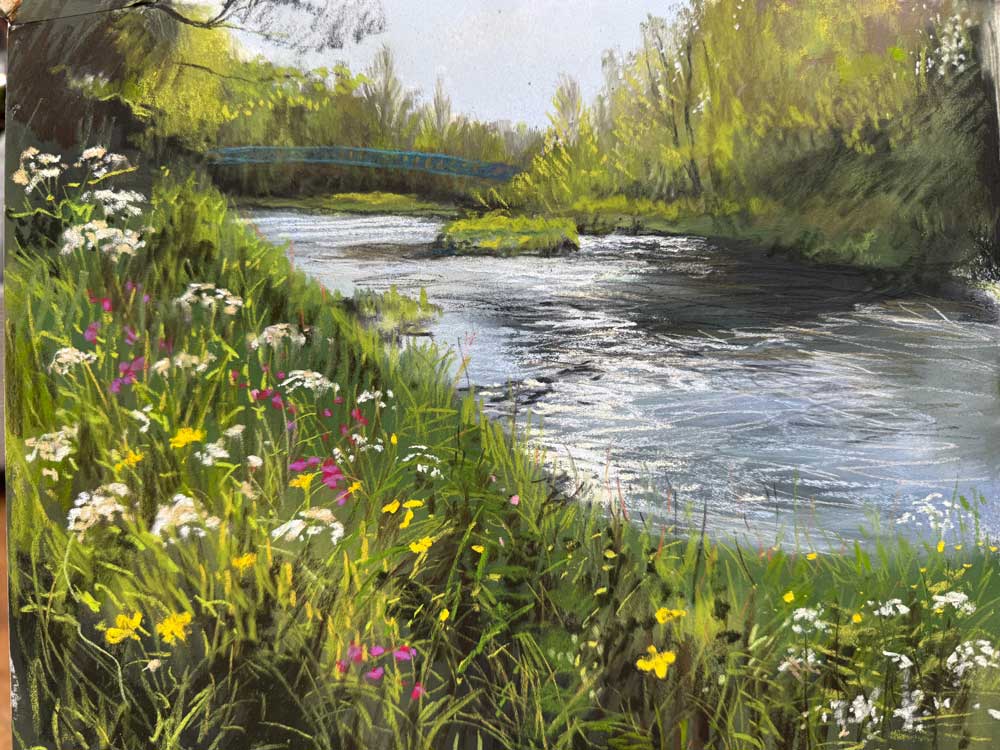
One of the things I love about planning workshops is that it gently forces me out of my usual habits.
When I am painting for myself, I naturally gravitate towards certain subjects. I know the kind of light, composition and atmosphere that usually appeals to me. I know the views that make me stop, take a photograph, or reach for my sketchbook. There is comfort in that, and I think every artist develops a kind of visual instinct over time.
But when I am planning a workshop, I often have to look at things differently. I took a view I’ve painted before, a different time of year and day. It gave me new challenges and I loved the result. You’ll often here me say, draw an image more than once, and in this situation, draw the same view regularly.
For a teaching subject, I might need a strong shape, a clear focus, a useful colour lesson, or a composition that allows people to practise a particular technique. Sometimes that means choosing an image I would not normally have picked for myself and I am often surprised by what I find.
The more I work with an image, the more I begin to see its possibilities. A view that seemed ordinary at first might have a lovely rhythm of light and dark. A slightly awkward photograph might contain a beautiful arrangement of shapes. A quiet corner, a simple path, a stretch of water, or a patch of grasses can suddenly become far more interesting once I begin to paint it.
It allows me to pull forward what I love and gently leave behind what I do not need. I can soften a distracting detail, simplify a busy background, exaggerate the light, change the emphasis, or quieten part of the scene so that the feeling of the place comes through more clearly.
That editing process is one of the most personal parts of making art.
Two artists could stand in exactly the same place, looking at exactly the same view, and create completely different paintings. One might be drawn to the sky, another to the shadows. One might notice the warmth in the grasses, another the shape of the path. We are not simply copying what is there. We are choosing what matters.
Every painting asks different questions.
I have been thinking about this recently because I read something about keeping the brain active by deliberately doing familiar things in unfamiliar ways. Even something as simple as driving to a place you know by a different route can wake up your attention. Instead of moving on autopilot, you have to notice again. You have to make fresh decisions.
I think painting can do something very similar.
When we always choose the same subjects, the same colours, the same compositions, we can become very comfortable but perhaps a little too comfortable. There is nothing wrong with returning to what we love, but sometimes a different way in can be exactly what we need.
A new subject asks different questions.
How can I make this work?
What is the painting really about?
What can I simplify?
What do I want the viewer to notice?
What feeling am I trying to keep?
Those questions are often more useful than simply asking whether the original view was “pretty enough” to paint.
Some of my favourite discoveries have come from places I didn’t expect. A view glimpsed on an ordinary walk. A corner of a garden. A cloudy day that seemed unpromising. A photograph I almost dismissed. Once I start looking properly, there is nearly always something there.
That is one of the quiet gifts of painting. It teaches us to look again. I am reminded of the Impressionists who I admire so much, they would paint in the same areas and often the same views through out the year and seasons.
Here’s the same view from but a different time of year and day.
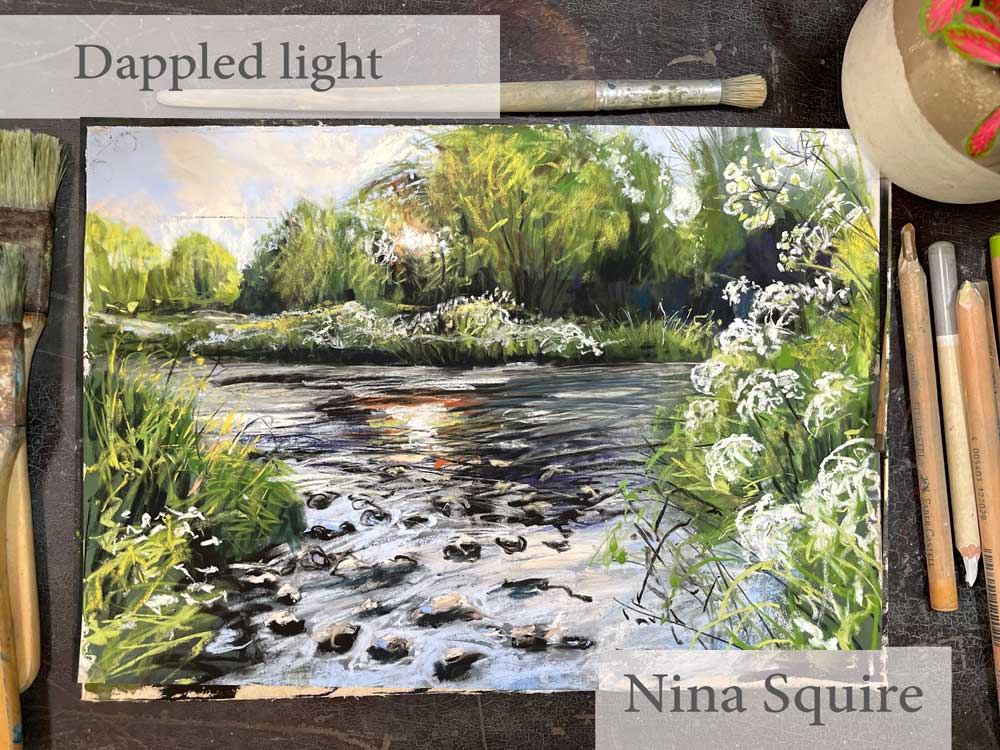
And perhaps that is why workshops can be so valuable, not just for students, but for me too. They encourage us to approach a subject with curiosity rather than certainty. They remind us that there is not one correct way to see a place. They give us permission to explore, simplify, edit and interpret.
The finished painting does not have to include everything. It only needs to hold onto what feels important.
So, the next time you are choosing something to paint, perhaps try taking a slightly different route. Choose the photograph you nearly ignored. Look again at the ordinary view. Ask yourself what you could bring forward, what you could leave out, and what the scene might become in your hands.
You may be surprised by what you find. Let me know if this approach helps.